FGT think your best choice in the future
System Integration Designers in FGT

The project utilizes smart building budget and planning architecture diagrams.

If the project needs to be imported Smart BuildingIt is usually divided into "Budget structure"and"System Planning ArchitecturePlanning should be done on two levels. The following is a complete framework commonly used in construction projects in Taiwan, suitable for presentations or project planning.
I. Smart Building Budget Architecture Diagram (Project Implementation)
Smart building total budget
│
├─ 1. Smart Building Consulting and Design
│ ├─ Smart Building Labelling Consultant
│ ├─ Low-voltage system design
│ ├─ BIM Integrated Design
│ └─ System Integration Planning
│
├─ 2. Basic Low-Voltage Electrical Engineering
│ ├─ Fiber optic backbone network
│ ├─ Structured cabling
│ ├─ Data Center Setup
│ └─ Network switching equipment
│
├─ 3. Smart Building Systems
│ ├─ BMS Building Management System
│ ├─ EMS Energy Management System
│ ├─ Smart Lighting Control
│ ├─ Smart Air Conditioning Control
│ ├─ Smart Water Resources Management
│ └─ Smart Parking Management
│
├─ 4. Security System
│ ├─ Access Control Management
│ ├─ CCTV surveillance
│ ├─ License Plate Recognition
│ ├─ Burglar Alarm
│ └─ Visitor Management
│
├─ 5. Internet of Things (IoT) Sensing Devices
│ ├─ Air Quality Sensor
│ ├─ Water Flow Monitoring
│ ├─ Power Monitoring
│ └─ Temperature and humidity sensing
│
├─ 6. Smart Resident Services
│ ├─ Community App
│ ├─ Smart Intercom
│ ├─ Delivery Management
│ └─ Public Reservation System
│
└─ 7. System Integration and Testing
    ├─ System Integrator (SI)
    ├─ Platform Integration
    ├─ Testing and Acceptance
    └─ Application for Smart Building Certification
Typical project budget proportions (for reference)
| project | Budget ratio |
|---|---|
| Low-voltage electrical infrastructure construction | 30–40% |
| Intelligent system equipment | 35–45% |
| Security system | 10–15% |
| system integration | 5–10% |
| Consultants and Brands | 3–5% |
Smart building budgets are typically around Total construction cost: 1%–3%.
The cost of building a smart building is usually higher than that of a regular building, and the specific cost depends on the certification level applied for (Qualified, Bronze, Silver, Gold, Diamond).
1. Regulatory fees and certificate fees:
New applications and renewals: NT$1,000 per application (TP4T1,000).
Replacement or additional cases: NT$$500 per case.
2. Budget for hardware and software construction:
Low-voltage system engineering: This includes monitors, access control, network cabling, telephone and intercom systems, which constitute the core of the smart system budget.
System linkage control: For example, setting CO2 detection to "link" with ventilation equipment to obtain indicator scores requires additional budget for such linkage control hardware.
3. Design and consulting fees:
Smart building planning fee: If an architect is commissioned to conduct a comprehensive design or to handle the bidding process, the fee will be calculated based on the total floor area. For example, under the comprehensive design incentive program, approximately NT$$24 will be added per square meter as a basic design reference.
Electronic Block Application: Using standard electronic blocks to create design drawings can earn 3 points in the evaluation, which helps reduce the cost of subsequent review and revision.
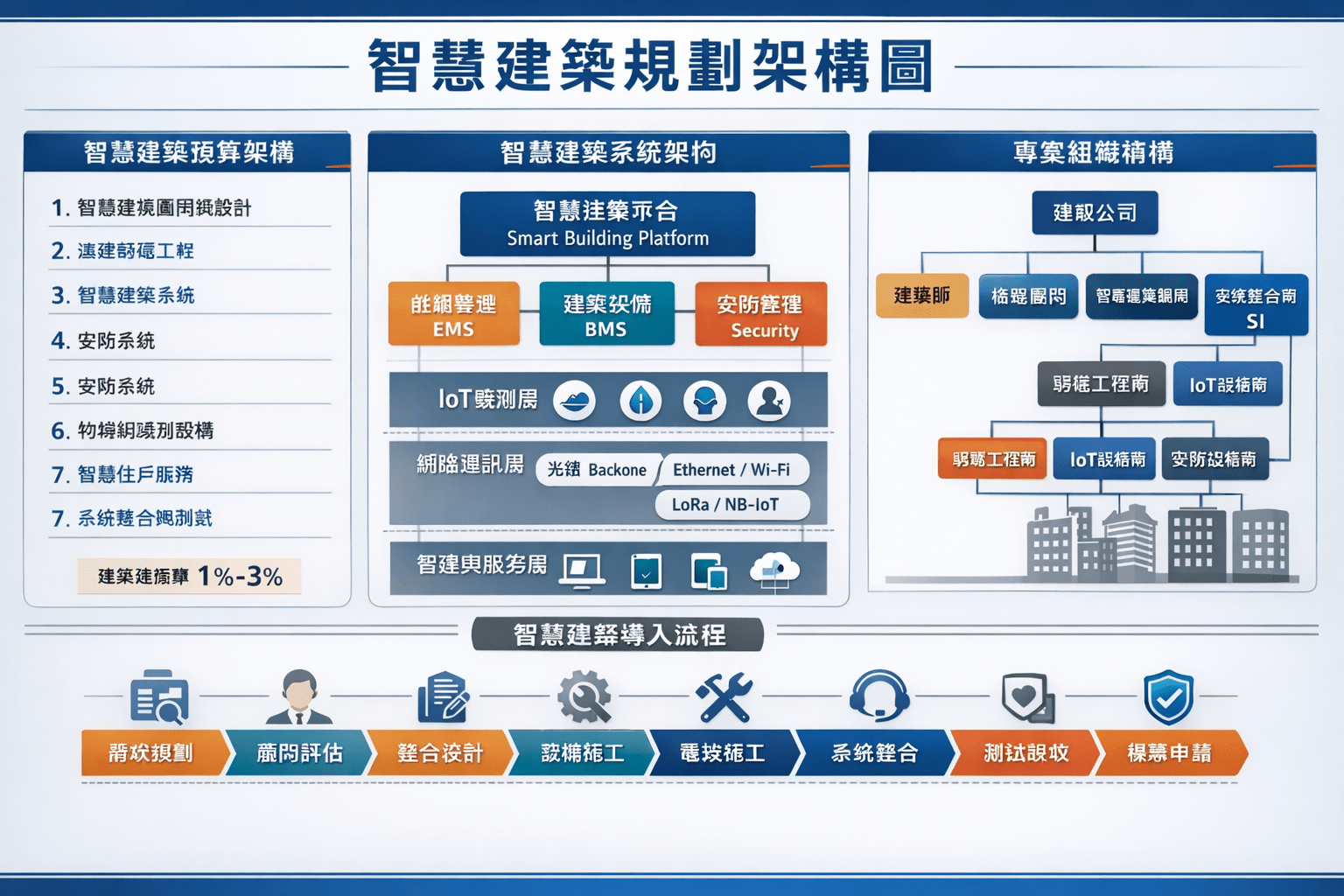
II. Smart Building System Planning Architecture Diagram
     Smart building platform
    (Smart Building Platform)
                        ┌────────┼───────────────────┐
Energy management, building equipment, and security management
EMS System BMS System Security
Power monitoring, water flow control, air conditioning control, lighting control, elevator monitoring, CCTV, access control, license plate recognition.
Power Water HVAC Lighting Elevator Camera Access LPR
Meter Flow
 │
              IoT sensing layer
 ┌───────────────┼───────────────┐
 │ │ │
Temperature, humidity, air quality, and people count sensors.
                Network communication layer
                ├─ Fiber Optic Backbone
                ├─ Ethernet
                ├─ WiFi
                └─ LoRa / NB-IoT │
               Management and Service Layer
               ├─ Management Center Dashboard
               ├─ Resident App
               ├─ Maintenance System
               └─ Cloud Platform
III. Organizational Structure for Smart Building Projects
Construction Company
   │
   ├─ Architect
   │
   ├─ Mechanical and Electrical Consultant
   │
   ├─ Smart Building Consultant
   │
   └─ System Integrator (SI)
        │
        ├─ Low-voltage electrical engineering contractor
        ├─ IoT device vendors
        ├─ BMS vendors
        Security Equipment Supplier
        └─ Software platform provider
IV. Smart Building Implementation Process
Demand planning
   ↓
Smart Building Consultant Assessment <----- FGT's Mark Designer Design
   ↓
Low-voltage and electromechanical integration design <-----Designed by FGT's electrical engineers
   ↓
Intelligent System Planning - Designed by FGT's Engineering Technicians
   ↓
Equipment Procurement
   ↓
Low-voltage electrical installation <-----Designed by FGT's Engineering Department
   ↓
System Integration - Designed by FGT's Cloud ECC Team
   ↓
Test and Acceptance
   ↓
Smart Building Certification Application <----- Handled by FGT's Certification Specialists
💡 Smart building systems commonly used in Taiwanese construction projects
- BMS Building Management
- EMS Energy Management
- Smart Parking
- Security monitoring
- Smart Lighting
- Air quality monitoring
- Flow meter production by FGT's manufacturing division.