FGT think your best choice in the future
System Integration Designers in FGT

How to choose a liquid flow meter? Differences between electromagnetic, turbine, Coriolis, and vortex flow meters.
Want to know how to choose a liquid flow meter? Different liquids require different measurement principles. Whether it's clean water, wastewater, oil, chemical liquids, or steam, each will affect the accuracy and lifespan of the flow meter. This article summarizes common types of liquid flow meters, their working principles, key selection points, installation precautions, and differences between various flow meters to help you quickly find the most suitable flow measurement solution.

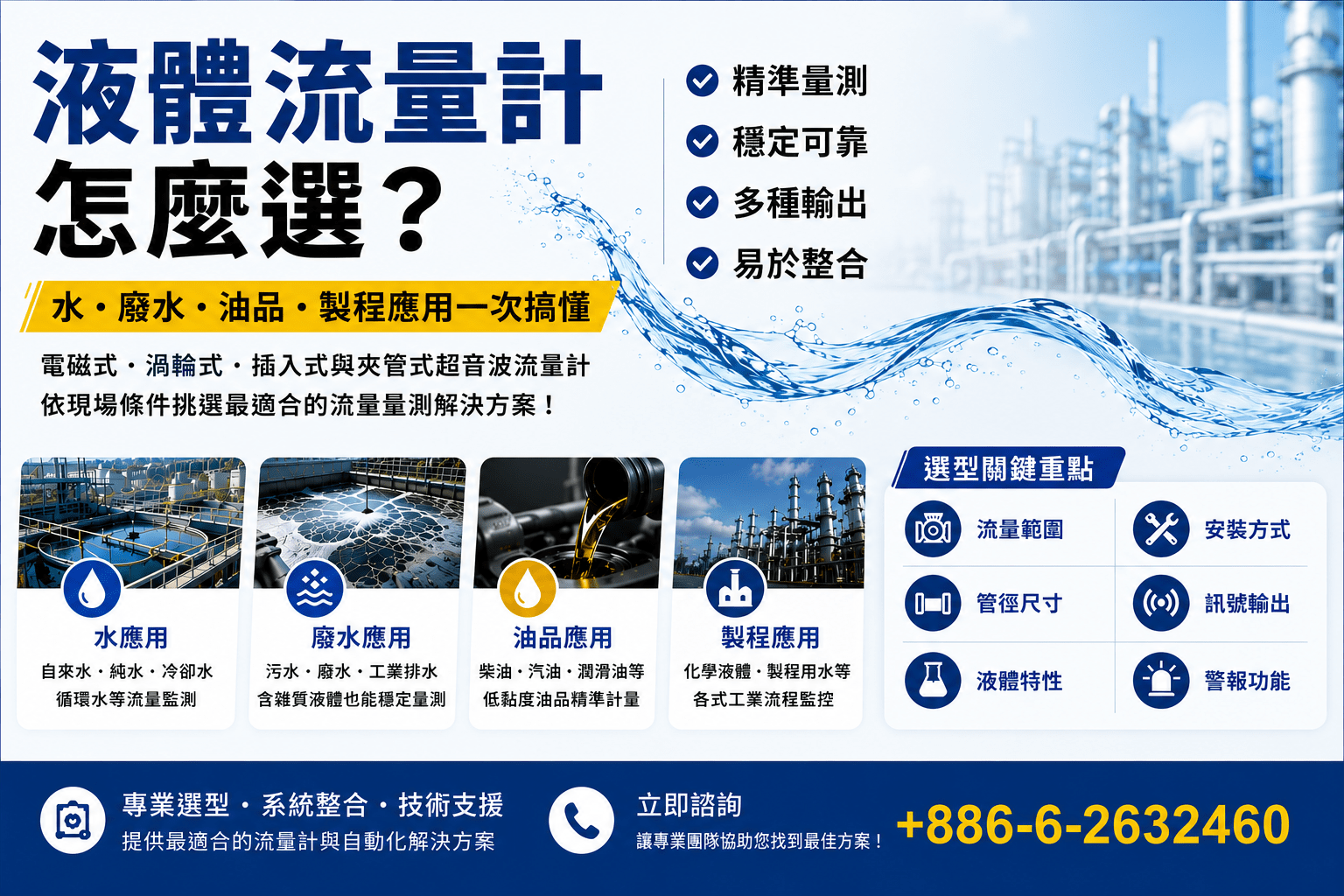
Liquid flow meters are indispensable in various industries, including waterworks, semiconductor manufacturing, PCB production, chemicals, food processing, biotechnology, air conditioning chilled water systems, and even wastewater treatment plants. Many people believe that knowing the pipe diameter is sufficient to select a suitable flow meter, but in reality, the type of liquid, its conductivity, viscosity, flow rate, temperature, pressure, and installation environment all affect the selection of the flow meter.
Choosing the wrong flow meter can not only cause measurement errors, but also lead to equipment malfunctions, increased pressure loss, higher maintenance costs, and even affect the operation of the entire production line. Therefore, understanding the measurement principles and applicable scenarios of various flow meters before purchasing them is an important foundation for ensuring stable measurements and reliable equipment operation.
Table of Contents
- What is a liquid flow meter? Why can't the same flow meter be used for different liquids?
- What types of liquid flow meters are there? A summary of common measurement principles.
- What factors should be considered when selecting a liquid flow meter?
- What precautions should be taken before installing a liquid flow meter?
- How to choose a liquid flow meter? Let First General Technology assist with the evaluation for greater peace of mind.
- Frequently Asked Questions (FQA)
What is a liquid flow meter? Why can't the same flow meter be used for different liquids?
What data does a liquid flow meter primarily measure?
The main purpose of a liquid flow meter is to measure flow information in pipelines. Common measurement items include:
- Instantaneous flow rate (L/min, m³/hr)
- Cumulative traffic
- flow rate
- Forward and reverse traffic
- Volumetric flow rate
- Mass flow rate (partial flow meter)
In addition to flow monitoring, modern smart liquid flow meters can also be equipped with PLC, SCADA, MODBUS RTU, RS485, 4~20mA, Pulse, NB-IoT, WiFi and other communication methods to achieve remote monitoring and cloud management, thereby improving the level of factory intelligence.
Do the conductivity, viscosity, and impurities of a liquid affect the measurement?
The answer is yes, and the impact will be enormous.
Different flow meters have different measurement principles, and therefore are suitable for different fluids.
E.g:
- Electromagnetic flow meters are ideal for use with conductive liquids such as tap water, pure water, and wastewater.
- Low-viscosity oils such as diesel, gasoline, and methanol are more suitable for turbine flow meters.
- High-viscosity fluids, food ingredients, or special chemical liquids may require a Coriolis flow meter.
- For steam, high-temperature liquids, and compressed air, Karman eddy current flow meters are commonly used.
If the liquid contains a large number of bubbles, solid particles or sediments, it may also affect the measurement stability of some flow meters. Therefore, fluid characteristics must be considered when selecting a flow meter.
What are the differences between volumetric flow meters and mass flow meters?
The most common application in general industrial applications is volumetric flow.
E.g:
- L/min
- L/hr
- m³/hr
This type of flow rate can vary depending on changes in temperature, pressure, and density.
andMass FlowThen directly measure the actual mass of the medium flowing through it, for example:
- kg/hr
- ton/hr
Therefore, Coriolis flow meters are mostly used in processes that require precise ingredient mixing, such as those in the food, chemical, and pharmaceutical industries.
What problems might occur if the wrong liquid flow meter is selected?
Many abnormal measurements in the field are not actually caused by flow meter malfunctions, but by incorrect selection.
E.g:
- When I used the electromagnetic flowmeter to measure diesel fuel, there was absolutely no signal.
- The turbine flow meter is used to measure high-viscosity oil, and the impeller cannot rotate normally.
- The ultrasonic flow meter measures a large amount of bubbly liquid, and the readings fluctuate wildly.
- The insertion flow meter is installed in the wrong location, resulting in uneven flow velocity distribution.
Therefore, there is no "best" flow meter, only the "most suitable".
What types of liquid flow meters are there? A summary of common measurement principles.
How does an electromagnetic flowmeter measure conductive liquids?
Electromagnetic flow meters are one of the most common liquid flow meters in industry today.
Its principle is derived from Faraday's law of electromagnetic induction.
When a conductive liquid flows through a magnetic field, an induced voltage is generated. Electrodes can then measure this voltage and calculate the flow rate and volume.
The most significant features of electromagnetic flowmeters include:
- No mechanically rotating parts
- Almost no pressure loss
- Unaffected by liquid density
- Suitable for large diameter pipes
- Bidirectional vector measurement
- High precision
Depending on the application, you can choose:
- FMG-E Integrated Electromagnetic Flow Meter: Suitable for general water flow monitoring.
- FMG-C Integrated Electromagnetic Flow Meter: Suitable for sewage, wastewater and industrial processes.
- FMG-W Wireless Smart Electromagnetic Flow Meter: Supports NB-IoT and cloud monitoring.
- FMG-J insertion electromagnetic flow meter: suitable for large pipelines above DN100, can be installed without replacing the entire pipeline.
What types of oils and clean liquids are suitable for turbine flow meters to measure?
Turbine flow meters utilize liquid to drive an impeller to rotate, and then use a magnetic sensor to calculate the impeller speed, which in turn converts the flow rate.
Therefore, it is very suitable for:
- diesel fuel
- gasoline
- methanol
- Alcohol
- weak acid
- weak base
- Clean water
For example, the FRV-F series turbine flow meter uses an integrated CNC precision-machined impeller, which can effectively improve the stability of small flow measurement and supports multiple output methods such as 4~20mA, Pulse, RS485, MODBUS RTU and NB-IoT, making it suitable for boiler piping, air conditioning cooling systems, oil transportation and smart factory applications.
Why can a Coriolis flow meter directly measure mass flow rate?
The Coriolis Mass Flow Meter is widely recognized as one of the most accurate flow meters in the industry. Its biggest feature is that it directly measures mass flow rate, rather than converting volumetric flow rate through flow velocity. Therefore, it is not easily affected by changes in temperature, pressure, or density.
Its working principle utilizes the "Coriolis Effect". When a liquid flows through a vibrating measuring tube, the fluid will undergo slight torsional deformation due to its mass. The instrument can then measure the degree of deformation through a sensor and directly calculate the mass flow rate of the fluid.
Compared to other flow meters, the Coriolis flow meter can also measure:
- mass flow
- Liquid density
- Temperature Controller
- Volumetric flow rate (conversion)
Therefore, it is widely used in:
- Chemical ingredients
- Food and Beverage
- Biopharmaceuticals
- petrochemical industry
- High-value liquid metering
Although the price is relatively high, Coriolis flow meters are still a worthwhile investment if the process requires high precision, high repeatability and quality traceability.
What are the unique features of the Karman eddy flow meter compared to a general eddy flow meter?
The Karman vortex flow meter utilizes...Karman Vortex StreetWorking principle.
When fluid passes through a vortex generator, vortices of a fixed frequency are generated alternately on both sides. The vortex frequency is linearly proportional to the flow velocity, so the flow rate can be calculated simply by measuring the vortex frequency.
Its advantages include:
- Non-rotating parts
- Low maintenance cost
- Suitable for high temperature and high pressure environments
- It can measure liquids, gases and vapors.
- Good long-term stability
For example, FVF type eddy flow meters support:
- liquid
- gas
- steam
And built-in:
- Temperature compensation
- Stress compensation
- 4~20mA
- Pulse
- MODBUS RTU
- NB-IoT
- WiFi cloud monitoring
With a maximum temperature resistance of up to 420°C, it is ideal for applications such as boiler systems, steam piping, energy management, and smart factories.
Comparison of Electromagnetic, Turbine, Coriolis Force and Karman Eddy Flowmeters
Different measurement principles have their own suitable application environments. No single flow meter can be used for all liquids. Therefore, it is recommended to confirm the characteristics of the medium and process requirements before selecting a flow meter.
| Types of | Suitable media | advantage | Precautions |
|---|---|---|---|
| Electromagnetic Flowmeter | Clear water, wastewater, acid and alkali solutions | High precision, no pressure loss, corrosion resistant | Applicable only to conductive liquids |
| Turbine flowmeter | Diesel, gasoline, methanol, clean liquids | High precision, fast response, and low price | Not suitable for high-viscosity liquids and liquids containing impurities. |
| Coriolis flowmeter | Almost all liquids | Direct measurement of mass flow rate, highest accuracy | High cost |
| Karman Vortex Flowmeter | Liquids, gases, and vapors | It can measure various media, high temperature and high pressure. | The flow rate needs to reach a certain range for stable measurement. |
For large-scale tap water, sewage, or industrial processes, electromagnetic flow meters are usually the first choice; for oil metering, turbine flow meters are still a fairly mature solution; while for food, pharmaceutical, and chemical ingredients, Coriolis flow meters are often used; and for steam and energy management, Karman eddy current flow meters are the most common.
What factors should be considered when selecting a liquid flow meter?
Is the medium water, wastewater, oil, or a chemical liquid?
The first step in selecting a flow meter is to identify the medium being measured.
E.g:
- Clean water, tap water → Electromagnetic flow meter, ultrasonic flow meter
- Wastewater, sewage → Electromagnetic flowmeter
- Diesel and gasoline → Turbine flow meter
- High-purity chemical liquids → Coriolis flow meter
- Steam → Karman eddy current flow meter
If the medium is corrosive, it is also necessary to consider whether the electrode, lining, and wetted materials meet the usage requirements.
How do I determine the pipe diameter, flow velocity, and flow range?
Besides the medium, pipe diameter is also an important factor.
E.g:
- Small diameter (DN4~DN25)
- Medium diameter (DN25~DN100)
- Large diameter (DN100 and above)
For large water pipelines, the FMG-J insertion electromagnetic flow meter can be used, which has a low installation cost and is convenient for retrofitting existing pipelines.
If the flow rate varies greatly, attention should be paid to the flow meter's turndown ratio to avoid inaccurate measurement at low flow rates.
Do you need on-site display, alarms, or remote transmission?
In addition to measuring flow rate, modern smart factories also place great emphasis on data integration capabilities.
Many liquid flow meters are currently available:
- LCD display
- Instantaneous flow
- Cumulative traffic
- Upper and lower limit alarms
- Pulse
- 4~20mA
- RS485
- MODBUS RTU
- NB-IoT
- WiFi cloud monitoring
For example, the FMG-W, FRV-F, and FVF series can all be paired with the SMM cloud platform, allowing users to monitor equipment operation status in real time via mobile phone or computer, thus improving management efficiency.
How should we balance accuracy and budget?
Many users believe that the higher the accuracy, the better, but in reality, it is still necessary to evaluate according to the application requirements.
E.g:
- For general water management, ±1% to 2% is sufficient.
- Energy management: ±0.5% is ideal.
- Chemical ingredients: may require ±0.2% or less.
- Laboratory: Even higher precision is required.
If you are only monitoring traffic on a daily basis, choosing too high a specification will only increase procurement costs. Therefore, it is recommended to choose the product that best suits your actual needs.
What precautions should be taken before installing a liquid flow meter?
Even if a suitable liquid flow meter is selected, incorrect installation can still cause measurement errors, fluctuating readings, or even equipment malfunctions. Therefore, in addition to confirming the pipe diameter, medium, and flow direction before installation, it is also necessary to plan according to the characteristics of different flow meters to achieve optimal measurement performance.
Will insufficient straight pipe sections before and after affect the numerical values?
meeting.
Most velocity flow meters require a certain length of straight pipe section to allow the fluid flow to stabilize before measurement.
If the flow meter is immediately connected to:
- elbow
- Three-way
- pump
- valve
- Tube shrinkage
Both can easily cause turbulence in the flow field, leading to errors in the measurement values.
General recommendations:
- The upstream straight pipe section is approximately 5-10D.
- The downstream straight pipe section is approximately 3-5D.
- (D is the pipe diameter)
Different products still need to be adjusted according to the original manufacturer's installation specifications. If the installation space is limited, a rectifier can also be used to improve the flow conditions.
Will an incomplete pipeline cause the electromagnetic flowmeter to malfunction?
The answer is yes, and the impact is very significant.
Electromagnetic flowmeters measure flow by utilizing the induced voltage generated when a conductive liquid cuts magnetic lines of force; therefore, the measuring tube must be kept full.
If it occurs:
- semi-pipe flow
- Gas accumulation inside the pipe
- Pipeline idling
- Insufficient liquid level
All of these could lead to:
- Low data usage is detected.
- Numerical fluctuations
- Unmeasurable
- Air traffic control alarm
Therefore, it is usually recommended to install:
- Vertical upward flow
- Avoid installing at the highest point
- Avoid installing near the exhaust outlet
- Avoid locations where air can easily accumulate inside the pipe.
This ensures that the sensor remains continuously immersed in the liquid.
Which flow meters are affected by bubbles, sediment, and vibration?
Different flow meters have different sensitivities to fluid conditions.
E.g:
- Electromagnetic flowmeter:If the liquid contains a large number of air bubbles, it may cause unstable electrode contact and result in signal fluctuations.
- Turbine flow meter:If the liquid contains sand, iron filings or a large number of impurities, it will easily wear out the impeller bearing, reduce the measurement accuracy and service life, so it is more suitable for clean liquids.
- Karman eddy current flow meter:If the pipeline vibrates too much, it may affect the determination of the eddy current frequency. Therefore, the installation location should be avoided as much as possible from large mechanical equipment or strong vibration sources.
- Ultrasonic flow meter:If the proportion of air bubbles in the fluid is too high, or if the medium cannot effectively transmit ultrasonic waves, it will also affect the measurement stability; while clamp-type ultrasonic flow meters need to ensure that the probe is in tight contact with the pipe wall in order to maintain good signal quality.
Therefore, in addition to confirming the pipeline configuration before installation, the on-site fluid conditions should also be assessed. If necessary, filters, venting devices, or vibration damping measures can be used to improve measurement quality.
How often should calibration and maintenance be performed?
Flow meters are not completely maintenance-free after installation.
General recommendations:
- For general industrial use: calibration is required approximately every 1 to 2 years.
- For high-precision processes in food and pharmaceutical industries, calibration cycles can be shortened by following ISO or GMP standards.
If the fluid contains deposits, crystals, or corrosive media, the electrodes, sensors, and internal components must be inspected regularly.
In addition, the self-diagnostic function of smart flow meters can detect abnormalities early and reduce the risk of equipment downtime.
How to choose a liquid flow meter? Let First General Technology assist with the evaluation for greater peace of mind.
In actual equipment selection, in addition to the type of medium, it is also necessary to simultaneously confirm the pipe diameter, normal flow rate, minimum and maximum flow rates, operating temperature, pressure, viscosity, conductivity, impurity content, installation space, signal output, and whether remote monitoring is required. If selection is based solely on price or pipe diameter, problems such as unstable measurements, insufficient accuracy, increased pressure loss, or shortened equipment lifespan can easily occur.
First General Technology Co., Ltd. is headquartered in Tainan Industrial Park, with a production and design plant of approximately 1,600 square meters. It integrates engineering planning, professional control component manufacturing, whole-plant equipment planning, and automation system design. Its services cover power monitoring, process monitoring, automation equipment, industrial equipment, multi-temperature controllers, liquid flow meters, and cloud, IoT, AI, and big data platform integration.
If you are evaluating electromagnetic flow meters, turbine flow meters, Karman vortex flow meters, ultrasonic flow meters, or other liquid flow meters, please provide the medium, pipe diameter, flow rate, temperature, pressure, and on-site installation conditions. First General Technology Co., Ltd. will assist with product selection, signal integration, and system planning to ensure more stable flow monitoring and better meet actual process requirements. Feel free to contact us now for recommendations on suitable liquid flow meters for your field equipment.
Frequently Asked Questions (FQA)
Q: What types of liquids can a liquid flow meter measure?
Common measurable media include tap water, pure water, wastewater, sewage, diesel, gasoline, methanol, weak acids, weak alkalis, chemical liquids, and some high-purity fluids. Different media require liquid flow meters with different measurement principles.
Q: Are water flow meters and liquid flow meters the same?
Water flow meters are a type of liquid flow meter, mainly used for applications such as clean water, tap water, and cooling water. Liquid flow meters have a wider range, including oil, chemical liquids, acid and alkali solutions, and other industrial fluids.
Q: Can an electromagnetic flow meter measure pure water or oil?
Electromagnetic flow meters can only measure liquids with a certain degree of conductivity. They can generally measure tap water, wastewater, and most conductive liquids; however, they are not suitable for non-conductive oils such as diesel and gasoline.
Q: Are turbine flow meters suitable for measuring high-viscosity oils?
Not recommended. Turbine flow meters are best suited for low-viscosity, clean liquids free of impurities, such as diesel, gasoline, methanol, and general industrial liquids. High viscosity may affect impeller rotation and reduce measurement accuracy.
Q: What are the differences between Coriolis flow meters and electromagnetic flow meters?
The biggest difference lies in the measurement method. Coriolis flow meters can directly measure mass flow rate and are not affected by liquid density; electromagnetic flow meters measure volumetric flow rate, are suitable for various conductive liquids, are usually less expensive, and have a wide range of applications.
Q: Can the Karman eddy flow meter measure both liquid and steam simultaneously?
Yes. Karman eddy current flow meters can measure not only liquids but are also widely used for gas and steam flow monitoring, and are therefore commonly found in boiler systems, energy management, and industrial steam pipelines.
Q: Does the clamp-type ultrasonic flow meter require shutdown for installation?
Generally, this is not necessary. The clamp-on ultrasonic flow meter adopts a non-invasive design, which only requires fixing the sensor to the outside of the pipe wall. There is no need to cut the pipe or stop the machine, making it very suitable for the retrofitting of existing equipment and smart monitoring applications.
Q: What pipe diameter is suitable for an insertion flow meter?
Insertion flow meters are particularly suitable for use in large-diameter pipes, such as water or industrial pipelines with a diameter of DN100 or larger, as they can reduce installation costs and facilitate the retrofitting of existing pipelines.
Q: Is higher accuracy always better for liquid flow meters?
Not necessarily. For general water usage monitoring or energy management, excessively high precision may not bring practical benefits and could even increase procurement costs. It is recommended to choose products with appropriate precision based on process requirements and budget.
Q: What could be causing the unstable flow count?
Common causes include air bubbles in the pipe, incomplete pipe filling, unstable flow field, insufficient straight pipe sections before and after the pipe, impurities in the fluid, vibration interference, improper installation location, or the need for sensor calibration. If the abnormality persists for a long time, it is recommended to have it inspected and calibrated by a professional.