FGT think your best choice in the future
System Integration Designers in FGT

How to Choose a Liquid Flow Meter for Your Applications? Introduction to Flow Measurement Equipment for Water, Wastewater, Oil, and Processes
Looking for a suitable liquid flow meter for water, wastewater, oil, and process pipelines? This page summarizes the application differences between electromagnetic, turbine, insertion, and clamp-type ultrasonic liquid flow meters, explaining key selection factors such as flow rate, pipe diameter, viscosity, conductivity, installation method, signal output, and alarm functions to help you choose the right liquid flow meter for your site conditions. Click to see more product information, or contact First General Technology immediately for professional selection and system integration advice.

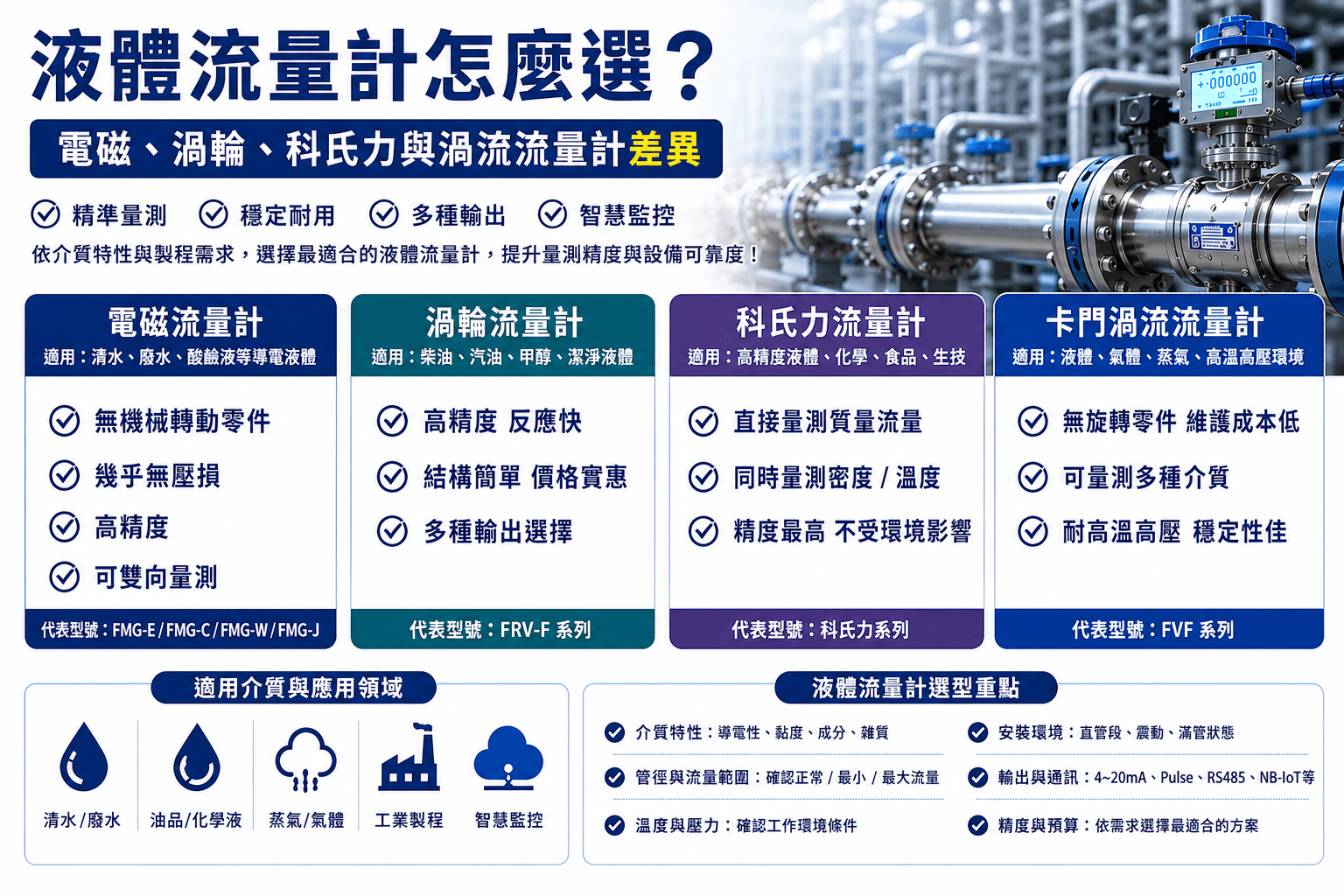
Looking for a liquid flow meter but unsure which type to choose: electromagnetic, turbine, insertion, or ultrasonic?
In fact, there is no single specification of liquid flow meter that can be applied to all pipelines. Clean water, wastewater, diesel oil, lubricating oil, and process liquids all differ in conductivity, viscosity, impurities, temperature, and flow range, and therefore the appropriate measurement principles also differ.
This article will start with common applications such as clean water, wastewater, oil, and process pipelines, and summarize the differences between electromagnetic flow meters, insertion flow meters, flow switches, turbine flow meters, and clamp-type ultrasonic flow meters to help you find the right liquid flow meter for your field application based on the characteristics of the medium, the installation environment, and control requirements.
Table of Contents
- Why are different flow meters needed for different liquids and operating environments?
- How to select a liquid flow meter for a water and wastewater system?
- Which devices are suitable for insertion flow meters and flow switches?
- Are turbine flow meters suitable for oils and clean liquids?
- Can a clamp-type ultrasonic flow meter be used when it is inconvenient to cut the pipe?
- Liquid Flow Meter Product Selection and Installation Process
- Selecting the appropriate liquid flow meter based on the medium and site conditions is essential for stable measurement.
- Frequently Asked Questions (FQA)
Why are different flow meters needed for different liquids and operating environments?
Liquid flow meters are not a single product that can cover all applications. Even if two pipelines have the same diameter, different liquid types, flow rates, or control requirements may necessitate completely different measurement principles.
What measurement conditions are important for clean water and circulating water systems?
Clean water, tap water, cooling water, and air conditioning circulating water usually have a certain degree of conductivity and relatively stable fluid state. Therefore, common choices include electromagnetic flow meters, insertion flow meters, and clamp-type ultrasonic flow meters.
However, the actual application must be confirmed when making a selection. For accurate recording of instantaneous flow rate and cumulative water consumption, an electromagnetic flow meter can be evaluated; for large pipelines or retrofitting of existing pipelines, an insertion electromagnetic flow meter can be considered; if the pipeline is inconvenient to cut or cannot be shut down for a long time, a clamp-on ultrasonic flow meter can be used.
In addition to flow rate readings, air conditioning and cooling circulation systems often require monitoring of water temperature and low flow conditions. Insufficient cooling water can lead to decreased condenser heat dissipation efficiency; insufficient chilled water can also cause abnormal evaporator load. Therefore, these systems sometimes require not only liquid flow meters but also flow switches for safety interlocking.
Will the flow meter get clogged if the wastewater contains impurities?
Wastewater, sewage, and process drainage often contain suspended solids, sludge, fibers, oil films, or other impurities. If a flow meter with an internal impeller, gears, or narrow flow channel is used, particles may cause jamming, wear, or measurement errors.
Electromagnetic flowmeters typically have no rotating moving parts inside the measuring tube, and the fluid does not need to push the blades as it passes through, making them more suitable for conductive sewage and wastewater. Even so, it is still necessary to ensure that the electrode and lining materials are suitable for the corrosive properties of the liquid, and to avoid excessive deposits adhering to the electrode surface.
If the wastewater contains a large amount of air bubbles, grease, or substances that easily form scale, the measurement stability may still be affected. "Suitable for wastewater" does not mean completely maintenance-free, but rather that it is less prone to mechanical clogging due to particles compared to mechanical flow meters.
Will the measurement results be affected if the oil viscosity is different?
Yes. Diesel, gasoline, methanol, lubricating oil, and heavy oil have very different viscosities, and viscosity directly affects the ability of a liquid to drive turbine blades.
Turbine flow meters are best suited for clean, low-viscosity liquids free of significant impurities. When the oil viscosity is too high, the impeller's rotational resistance increases, potentially preventing smooth startup in low-flow areas and amplifying measurement errors. Furthermore, the presence of iron filings, sand particles, or crystals in the liquid can cause wear on the bearings and impellers.
Therefore, when selecting an oil flow meter, one should not only specify "diesel" or "oil type," but also provide the actual viscosity, operating temperature, normal flow rate, minimum flow rate, and maximum flow rate. Some oil types will exhibit significant viscosity differences with temperature variations, which must also be taken into account during the evaluation.
Do process fluids require real-time alerts or continuous flow data?
Before purchasing a liquid flow meter, you should first determine whether the actual requirement on site is a "numerical value" or a "state".
To perform usage statistics, process monitoring, energy management, or cost analysis, it is usually necessary to continuously output instantaneous and cumulative flow rates, and may be connected to PLC, SCADA, BMS, or cloud platforms.
If the equipment only needs to confirm whether the flow rate is below a safe value, such as for pump dry run protection, cooling water interruption alarm, or air conditioning unit interlock, using a flow switch may be more suitable.
Common needs can be categorized as follows:
- On-site inspection of instantaneous flow
- Record cumulative usage
- Set high and low flow alarms
- Control the start and stop of pumps or compressors
- Transmit 4-20mA or pulse signal
- Connect the control system using RS485 and MODBUS RTU.
- Remote monitoring via NB-IoT, Wi-Fi, or cloud platform
If the definition is not clear from the beginning, you may end up buying a device that can display flow rate but cannot output alarms, or one that only has switch contacts but cannot provide continuous flow data.
How to select a liquid flow meter for a water and wastewater system?
Although both water and wastewater systems use water as the main medium, the appropriate equipment will vary depending on the water quality, pipe diameter, impurities, and management objectives.
What water flow applications is the FMG-E integrated electromagnetic flow meter suitable for?
The FMG-E integrated electromagnetic flow meter can be used for measuring the flow rate of general clean water, tap water, circulating water, and industrial water. The electromagnetic principle utilizes the induced electromotive force generated when a conductive liquid passes through a magnetic field to calculate the flow velocity, and then calculates the volumetric flow rate based on the pipe diameter.
The integrated design combines the sensor and display converter into a single device, making it suitable for pipelines where space permits and operators can directly view flow data. Compared to mechanical devices with impellers, electromagnetic flow meters have no rotating parts, typically resulting in lower pressure loss and suitability for long-term continuous monitoring.
Common applications include:
- tap water delivery
- Industrial process water
- Air conditioning circulating water
- Cooling water system
- Building water management
- Water treatment equipment
When selecting a flow meter, it is still necessary to confirm the conductivity of the liquid. If it is ultrapure water with very low conductivity, it may not be suitable for a general electromagnetic flow meter, and a special equipment or ultrasonic flow meter should be used instead.
How does the FMG-C wastewater flow meter handle liquids containing impurities?
The FMG-C integrated electromagnetic flow meter can be used for conductive liquids such as sewage, wastewater, and industrial drainage. Its measuring tube has no impeller, eliminating the need for liquid-driven mechanical parts, thus reducing the risk of impurities getting stuck or blade wear.
The FMG-C is suitable for pipe diameters ranging from DN15 to DN3000, with an accuracy of approximately ±0.5%. It also features a Chinese/English LCD display. Output options include 4–20mA, pulse, and MODBUS RTU, facilitating integration with PLCs, monitoring systems, and flow accumulation management.
However, wastewater treatment system selection should not solely focus on "measurability." It is also necessary to confirm:
- Does the liquid have sufficient electrical conductivity?
- Are the electrode materials corrosion resistant?
- Whether the lining is resistant to acids, alkalis, abrasion and temperature
- Can the pipeline remain full?
- Does it contain a large number of air bubbles?
- Does sludge easily adhere to the electrodes?
If the wastewater has a high sand content, the abrasion resistance of the lining should also be assessed; if it contains acid or alkali solutions, the material compatibility needs to be confirmed based on the concentration and temperature.
Is the FMG-J insertion electromagnetic flow meter suitable for large pipelines?
Using a full-pipe electromagnetic flowmeter for large-diameter pipes can increase costs for the equipment itself, flanges, construction, and installation. The FMG-J insertion electromagnetic flowmeter measures the local flow velocity by inserting a probe into the pipe, and then calculates the overall flow rate based on the pipe diameter and flow velocity distribution, making it more suitable for large existing pipelines.
The FMG-J can be used for tap water, industrial water, water conservancy, wastewater and other conductive liquids, and supports forward and reverse flow measurement, as well as signal outputs such as 4-20mA, Pulse, and RS485.
The advantages of plug-in design include:
- Suitable for large diameter pipes
- The equipment is small in size
- Reduce the cost of large flange equipment
- Facilitates retrofitting of existing pipelines
- It can be applied to bidirectional flow or leakage monitoring.
However, insertion-type devices measure a representative flow velocity at a specific location within the pipe. Therefore, the installation location, insertion depth, pipe diameter setting, and flow field stability are crucial. If there are elbows, valves, pumps, or pipe reductions upstream, the uneven flow velocity distribution may affect the conversion results.
What management issues can the FMG-W wireless smart electromagnetic flow meter improve?
Traditional flow meters mostly rely on personnel to read the meters on-site. If the factory area is large, the flow meters are scattered, or the equipment is located in an area that is difficult to reach, manual meter reading is time-consuming and it is not easy to detect abnormalities in time.
The FMG-W wireless smart electromagnetic flow meter can be used with a wireless transmission and remote monitoring platform to transmit flow data to the management system. Managers can view real-time flow, cumulative flow, and abnormal statuses, reducing the burden of on-site inspections.
Suitable applications include:
- Large factory area water use
- Remote water station
- Building water use monitoring
- Industrial process flow management
- Analysis of water leakage and abnormal usage
- Smart factory integration with the Internet of Things
Wireless functionality does not mean that no on-site planning is needed. Power supply, communication signals, data upload frequency, platform compatibility, and network coverage environment still need to be confirmed.
Which devices are suitable for insertion flow meters and flow switches?
The advantages of insertion-type devices lie in their small installation size, wide applicability to pipe diameters, and the ability to integrate flow rate, temperature, alarm, and remote monitoring functions. These devices are commonly found in air conditioning, cooling water, and equipment protection systems.
How does the FSP900 insertion flow meter measure water flow and temperature?
The FSP900 is an insertion-type thermo-mass flow monitoring device that can measure the flow rate and temperature of water and oil. It is suitable for pipe diameters of approximately DN8 to DN350, with a flow rate range of approximately 0.03 to 3 m/s, and a protection rating of IP67.
The thermomass flow rate (TFR) principle uses the degree to which a fluid carries away heat to determine its velocity. The faster the fluid flows, the more heat is carried away from the sensor, and the velocity or flow rate status is then calculated based on the temperature change.
The FSP900 can be applied to:
- Air conditioning chilled water
- Water-cooled chiller cooling water
- Equipment circulating water
- Diesel generator oil tank
- Industrial machinery cooling system
- Pump flow monitoring
In an air conditioning system, the compressor can be started when the water flow reaches the set value; if the water flow drops due to leakage, blockage or pump malfunction, a signal can be output to stop the equipment to prevent evaporator icing, insufficient condenser heat dissipation or prolonged abnormal compressor operation.
Is the FSP500 flow switch suitable for low flow alarms?
The FSP500 is primarily positioned as an insertion-type thermoelectric flow switch, suitable for water and oil, with pipe diameters ranging from approximately DN8 to DN350. It can also be used for low flow alarms, pump protection, and equipment safety interlocks.
It does not necessarily provide complete continuous flow metering, but rather determines whether the flow rate is sufficient based on a set point. When the flow rate falls below a safe value, it can output an alarm or shutdown signal to prevent the pump from running dry, cooling interruption, or equipment overheating.
Common applications include:
- Pump dry run protection
- Cooling water low alarm
- HVAC water flow monitoring
- Mechanical equipment circulating water
- Experimental equipment
- Process piping safety interlocks
The FSP500 can also be paired with cloud-based software to view pipeline monitoring status, making it suitable for situations where remote monitoring of equipment operation is required.
What conditions should be considered when installing plug-in devices?
Insertion flow meters are easy to install, but they cannot be used accurately simply by inserting them directly after drilling a hole in the pipe. At least the following conditions must be confirmed during installation:
First, the insertion depth must meet the requirements of the product and the pipe diameter. If the probe is too deep or too shallow, it may be impossible to obtain a representative flow rate.
Second, the probe direction must be consistent with the flow direction. Some devices have clear flow direction markings; if the direction is incorrect, it may cause abnormal values.
Third, avoid areas near elbows, valves, tees, pump outlets, and neck reductions. These locations are prone to generating eddies or uneven flow velocities.
Fourth, the pipeline should be kept full. If there is cavitation or half-flow near the probe, the measurement results are prone to instability.
Fifth, pipeline pressure and construction safety must be confirmed. If existing pipelines need to be drilled or joints installed, it must be done in accordance with on-site pressure, shutdown conditions, and construction specifications.
Can a flow switch replace a liquid flow meter?
They cannot completely replace each other because their purposes are different.
Liquid flow meters primarily provide continuous numerical values, such as the current flow rate in liters per minute or the cumulative daily flow rate in cubic meters. Flow switches, on the other hand, determine whether the flow rate is higher or lower than a set value.
In short:
The liquid flow meter answers: "What is the current flow rate?"
The flow switch answers: "Is there enough flow now?"
If the factory needs to perform energy statistics, cost analysis, process records, or cumulative metering, a liquid flow meter should still be used. If the only requirement is to protect pumps or confirm that cooling water is flowing normally, a flow switch may be sufficient.
Some devices can also simultaneously display flow rate, monitor temperature, and output alarms. When purchasing, you should confirm the actual functions and not just judge based on the product name.
Are turbine flow meters suitable for oils and clean liquids?
Turbine flow meters are characterized by fast response, high accuracy and stable output signal, and are commonly used for diesel, gasoline, methanol, water and other low-viscosity clean liquids.
How does the FRV-F turbine flow meter measure oil flow rate?
The FRV-F turbine flow meter utilizes fluid to drive an impeller to rotate, with the impeller speed proportional to the flow velocity within its applicable range. The sensor converts the rotation signal into a pulse frequency, which is then used to calculate the instantaneous and cumulative flow rates.
The FRV-F is suitable for pipe diameters of approximately DN4 to DN200 and can measure low-viscosity liquids such as diesel, gasoline, methanol, water, weak acids and weak alkalis, which are free of large amounts of impurities and are not highly corrosive.
Products available:
- Standard accuracy is approximately ±1% R
- Optional ±0.5% R
- High precision type approximately ±0.2% R
- Pulse
- 4~20mA
- RS485
- MODBUS RTU
- NB-IoT
- Battery or DC power supply
- SMM Cloud Remote Meter Reading
Common applications include boiler piping, diesel delivery, air conditioning cooling systems, oil consumption monitoring, and digitization of existing pipeline flow rates.
Why is viscosity important when selecting an oil flow meter?
Turbine blades must be driven to rotate by the flow of liquid. The higher the viscosity, the greater the resistance the liquid exerts on the impeller and bearings, especially at low flow rates, where the impeller may not be able to start stably.
The viscosity of the same type of oil can vary significantly at different temperatures. Oil is thicker during cold starts-up, but as the equipment runs and the temperature rises, its viscosity decreases, potentially altering the flow meter's response and calibration conditions.
Therefore, the following should be provided when requesting a quote:
- Oil Name
- Operating temperature
- Dynamic viscosity or kinematic viscosity
- Normal traffic
- Minimum flow
- Maximum flow
- Pipe diameter and pressure
- Does it contain particles or impurities?
Providing only the "required amount of oil" is usually insufficient for making the correct selection.
Does a filter need to be installed at the front end of a turbine flow meter?
If the liquid may contain iron filings, welding slag, sand, fibers, or other solid impurities, it is recommended to evaluate the filter based on system conditions. These particles, once inside the flow meter, may wear down the impeller and bearings, or even cause it to seize up.
However, filters also increase system pressure differential and require regular cleaning. The filter precision should be determined based on the flow meter diameter, liquid cleanliness, and acceptable pressure drop.
Before a new pipeline is put into use for the first time, it should be cleaned to prevent construction residues from directly entering the flow meter.
Which types of oil are not suitable for direct use with turbine flow meters?
The following situations are generally unsuitable for the direct use of general turbine flow meters:
- High viscosity heavy oil
- Waste oil containing a large number of particles
- Oils that are prone to crystallization or solidification
- Liquid containing fibers or sediments
- Highly corrosive chemical liquids
- The flow rate has been consistently below the device's minimum measurement range.
- Systems with very obvious flow pulsations
If the medium has high viscosity, complex composition, or requires direct measurement of mass flow rate, a Coriolis flow meter, volumetric flow meter, or other suitable principle can be evaluated.
Can a clamp-type ultrasonic flow meter be used when it is inconvenient to cut the pipe?
Clip-on ultrasonic flow meters install the sensor on the outside of the pipe and calculate the flow velocity using the time difference in the propagation of ultrasonic waves in the forward and reverse flow directions. Because the sensor does not need to directly contact the liquid, it is particularly suitable for retrofitting existing pipelines.
What are the features of the UFMA clamp-type ultrasonic flow meter?
UFMA is mainly suitable for small and medium-sized water pipes with diameters from DN15 to DN50, with a flow velocity range of approximately 0.1 to ±5 m/s. It can be used with UPVC, carbon steel, and stainless steel pipes.
Its main features include:
- No need to cut the pipe
- The sensor does not contact the liquid.
- In most cases, downtime requirements can be reduced.
- No additional flow resistance is generated
- The signal can be transmitted to a PLC or computer.
- Suitable for retrofitting existing equipment with flow monitoring
Common applications include pure water for PCB wet processing, RO pure water, tap water, cooling water, water for smart buildings, and swimming pool circulation equipment.
What are the suitable applications for the UFMD clamp-type ultrasonic flow meter?
UFMD is suitable for medium to large water pipes, up to DN1200, with a flow velocity range of approximately 0.1 to ±5 m/s, an accuracy rating of approximately ±1.0% FS, and an instrument panel protection rating of IP65.
Compared to UFMA, UFMD is more suitable for:
- Large-scale circulating water in factories
- Cooling water main
- Water supply mains
- Building water use zone management
- water treatment plant
- Large swimming pool circulation
- Existing large-diameter pipeline renovation
- Energy and water management system
Although clamp-type ultrasonic flow meters are easy to install, the outer diameter of the pipe, the wall thickness of the pipe, and the distance between the pipe and the sensor must be entered correctly, otherwise significant errors may occur.
Which pipe materials and liquids can affect ultrasound signals?
Ultrasound waves must pass through the pipe wall and liquid to complete the measurement, so the acoustic properties of the pipe material and the medium are very important.
Common influencing factors include:
- Pipe wall corrosion
- Pipe scale
- Multi-layer coating
- Inner liner
- Insulation layer not removed
- Sensor not attached
- Insufficient coupling agent
- A large number of bubbles
- High concentration of suspended solids
- High viscosity liquid
- Pipeline not full
Transit-time ultrasonic flow meters are generally more suitable for homogeneous, clean liquids that allow for stable sound wave penetration. If the liquid contains a large number of bubbles or particles, other ultrasonic principles or electromagnetic flow meters may be required.
In addition, UFMA and UFMD product specifications use water as the primary test fluid. If measuring organic solvents or other chemical liquids, the velocity of sound, viscosity, temperature, pipe material, and product calibration conditions should be confirmed first; the parameters used for water cannot be directly applied.
Liquid Flow Meter Product Selection and Installation Process
If basic information is lacking when selecting a liquid flow meter, engineers will have to repeatedly ask questions, which can easily prolong the quotation and confirmation time. It is recommended to organize the information according to the following four steps.
Step 1: First, provide information on the medium, flow rate, and pipe diameter.
Before requesting a quote, please provide as much information as possible:
- Liquid Name
- Pipe diameter
- Pipes
- Normal traffic
- Minimum flow
- Maximum flow
- work pressure
- Operating temperature
- viscosity
- conductivity
- Does it contain particles, bubbles, or corrosive components?
- Do I need to accumulate traffic?
If the exact flow rate is unknown, you can provide pump specifications, equipment water consumption, pipeline design information, or current operating data so that engineers can assist in estimating it.
Step 2: Confirm the installation method and site space
Common installation methods include:
- Flange
- Threaded
- Wafer type
- plug-in
- Clip-on
- vertical installation
- horizontal installation
On-site checks also need to confirm whether the water supply can be shut off, whether the pipe can be cut, whether there are enough straight pipe sections, whether the equipment is located outdoors, and whether there is enough space for subsequent maintenance.
For example, FMG-J insertion electromagnetic flowmeters can be evaluated for large-diameter pipes; UFMA or UFMD can be evaluated for water pipes that cannot be cut; and FRV-F can be evaluated for small-diameter oil pipelines based on viscosity and flow rate.
Step 3: Confirm display, output, and alarm functions
If you only need to check the flow rate on-site, a basic LCD display may be sufficient; if you want to integrate an automation system, you need to confirm the signal and communication methods.
Common features include:
- Instantaneous flow
- Cumulative traffic
- Forward and reverse traffic
- Temperature display
- High and low flow alarms
- Relay
- Pulse
- 4~20mA
- RS485
- MODBUS RTU
- NB-IoT
- Wi-Fi
- Cloud monitoring
When connecting equipment to a PLC, BMS, SCADA, or enterprise management platform, it is best to confirm the communication protocol and data format before purchasing to avoid discovering incompatibility after installation.
Step 4: Arrange installation, testing and subsequent calibration
After the liquid flow meter is installed, the flow direction should be confirmed, the pipe diameter parameters should be set, the zero point should be checked, the signal should be tested, and the actual operation should be observed.
For electromagnetic flow meters, ensure the pipe is full and grounded; for turbine flow meters, ensure the flow direction, straight pipe section, and liquid cleanliness; for insertion devices, ensure the insertion depth; and for clamp-type ultrasonic flow meters, check the sensor spacing and signal quality.
There is no single fixed answer to the subsequent calibration cycle; it should be arranged according to the frequency of use, media characteristics, accuracy requirements, and quality control procedures. For general monitoring purposes, periodic checks are acceptable, while for high-precision processes, billing, or quality management purposes, a more explicit calibration procedure should be established.
Selecting the appropriate liquid flow meter based on the medium and site conditions is essential for stable measurement.
When selecting a liquid flow meter, price, pipe diameter, or highest accuracy should not be the sole considerations. For clean water and wastewater, the FMG series electromagnetic flow meter can be evaluated based on conductivity, impurities, and pipe diameter; for large pipelines, the FMG-J insertion design can be considered; for air conditioning, cooling water, and equipment protection, the FSP900 or FSP500 can be paired; for diesel, gasoline, and low-viscosity clean liquids, the FRV-F turbine flow meter can be evaluated; if existing water pipes are inconvenient to cut, the UFMA or UFMD clamp-type ultrasonic flow meter can be considered.
First General Technology Co., Ltd. is headquartered in Tainan Industrial Park, with a production and design plant of approximately 1,600 square meters. It integrates engineering planning, professional control component manufacturing, whole-plant equipment planning, and automation system design. Its services cover power monitoring, process monitoring, automation equipment, industrial equipment, multi-temperature controllers, flow meters, and cloud, IoT, AI, and big data platform integration.
If you are evaluating water flow meters, wastewater flow meters, oil flow meters, insertion flow meters, or clamp-type ultrasonic flow meters, please provide the medium, pipe diameter, flow rate, temperature, pressure, and installation environment. First General Technology Co., Ltd. will assist with product selection, signal integration, and system planning. Feel free to contact us now for recommendations on liquid flow meters tailored to your site conditions.
Frequently Asked Questions (FQA)
Q: What information is required for a quote on a liquid flow meter?
We recommend providing the liquid name, pipe diameter, normal flow rate, minimum and maximum flow rates, temperature, pressure, viscosity, conductivity, pipe material, installation method, and signal output requirements. The more complete the information, the easier it will be to select a suitable product.
Q: Should I choose an electromagnetic or ultrasonic water flow meter?
If the liquid is conductive and can be installed by cutting the pipe, an electromagnetic flow meter is generally recommended, as it is suitable for long-term stable monitoring. If existing pipelines are inconvenient to cut or if it is desirable for the sensor not to come into contact with the liquid, a clamp-on ultrasonic flow meter can be selected.
Q: Can a turbine flow meter be used if the wastewater contains impurities?
Generally, it is not recommended. Particles and impurities in wastewater can easily cause turbine blade wear or jamming, affecting measurement accuracy and equipment lifespan. Electromagnetic flow meters are usually more suitable for conductive wastewater.
Q: What are the advantages of insertion flow meters?
Insertion flow meters are small in size and highly flexible in installation, making them suitable for large-diameter pipes and retrofitting existing pipelines, thus reducing equipment and construction costs. However, attention must be paid to the installation location and insertion depth to avoid affecting measurement accuracy.
Q: Does a clamp-type ultrasonic flow meter need to come into contact with the liquid?
No. The sensor of the clamp-on ultrasonic flow meter is installed on the outside of the pipe and does not directly contact the liquid, but it is necessary to ensure that the sensor fits well against the pipe wall for stable measurement.
Q: Why is it necessary to check the viscosity of an oil flow meter?
Oil viscosity affects the fluid's ability to drive the impeller. Excessively high viscosity can lead to inaccurate flow rate measurements or introduce errors; therefore, the actual viscosity and operating temperature must be provided when selecting a pump.
Q: Can the flow switch display the actual flow rate?
This is generally not recommended. Flow switches are primarily used to determine whether the flow rate has reached the set value and to output a switch signal. If you need to display instantaneous or cumulative flow, you should select a flow meter with measurement capabilities.
Q: Why do the readings of a liquid flow meter become unstable after installation?
Possible causes include insufficient straight pipe section, incomplete pipe filling, air bubbles in the liquid, flow fluctuations, incorrect sensor orientation, or poor installation location. Installation conditions and the site environment can all affect measurement stability.
Q: Can a flow meter display both instantaneous flow and cumulative flow simultaneously?
Most electronic flow meters have the function of displaying both instantaneous flow and cumulative flow, but it is still necessary to check the product specifications to confirm whether this is supported.
Q: How often should a flow meter be maintained after installation?
Maintenance frequency depends on the nature of the liquid and the operating environment. Clean water systems only require periodic inspections; however, for wastewater, oil, or liquids containing impurities, the frequency of cleaning and inspection needs to be increased to ensure measurement accuracy and equipment lifespan.