FGT think your best choice in the future
System Integration Designers in FGT

FGT think your best choice in the future
System Integration Designers in FGT
- 2025-08-26
- 3:03 pm
How to calibrate and maintain flow meters? Calibration cycle, inspection process and maintenance tips
Flow meters are indispensable key equipment in process control across various industries. Whether in food production lines, chemical plants, semiconductor manufacturing processes, or water treatment plants, the accuracy of flow meters directly affects product quality, safety, and regulatory compliance. However, with increased usage time, the accuracy of flow meters can gradually deviate from standards due to environmental and equipment factors. Therefore, regular calibration and maintenance are crucial for ensuring measurement reliability.
Why do flow meters need to be calibrated periodically?
Although flow meters are precisely designed, the following factors may cause reading errors during long-term operation:
Scale and contaminants: After prolonged use, oil, scale, and chemical deposits may accumulate on the flow channels and probe surfaces, affecting the sensitivity of the sensing elements.
Component aging and wear: Sensors, electronic components and mechanical parts will age over time and with increased usage frequency, resulting in slower response times or signal drift.
Environmental interference: High temperature, low temperature, vibration, electromagnetic interference, etc., can all affect the stability and accuracy of the flow meter.
For the manufacturing process, flow rate errors may lead to:
- Food proportions are unbalanced, and the taste and quality do not meet standards.
- Decreased purity of semiconductor or medical gases affects product yield.
- Unable to pass regulatory verification or third-party testing
Therefore, the regular calibration of flow meters is not only a part of maintenance and repair, but also the foundation of industrial safety, quality and compliance management.
Common flow meter calibration methods
The calibration methods for flow meters vary depending on the device model, usage scenario, and regulatory requirements. The following are some common methods:
1. On-site comparison method
This method synchronizes the readings of the flow meter in use with those of a certified standard measuring instrument, compares the differences, and performs calibration. It is suitable for applications where disassembly is inconvenient and rapid testing is required.
2. Standard Fluid Method
Simulation tests are conducted using standard fluids with known flow rates and volumes (such as deionized water or gases at specific pressures) to observe the differences between the flow meter readings and the standard values. This method is commonly used in laboratories and metrology labs.
3. Zero-point calibration
When the fluid is completely still, the flow meter output is zeroed to eliminate deviations caused by electronic drift or temperature effects. This method is simple and quick, but it is usually only an auxiliary calibration.
4. Original factory return for inspection
Send the flow meter back to the original manufacturer or a third-party testing organization for full-range testing and recalibration using high-precision standard equipment. Although this process is more time-consuming, it offers the highest accuracy and is suitable for industries with high precision requirements or stringent regulatory requirements.
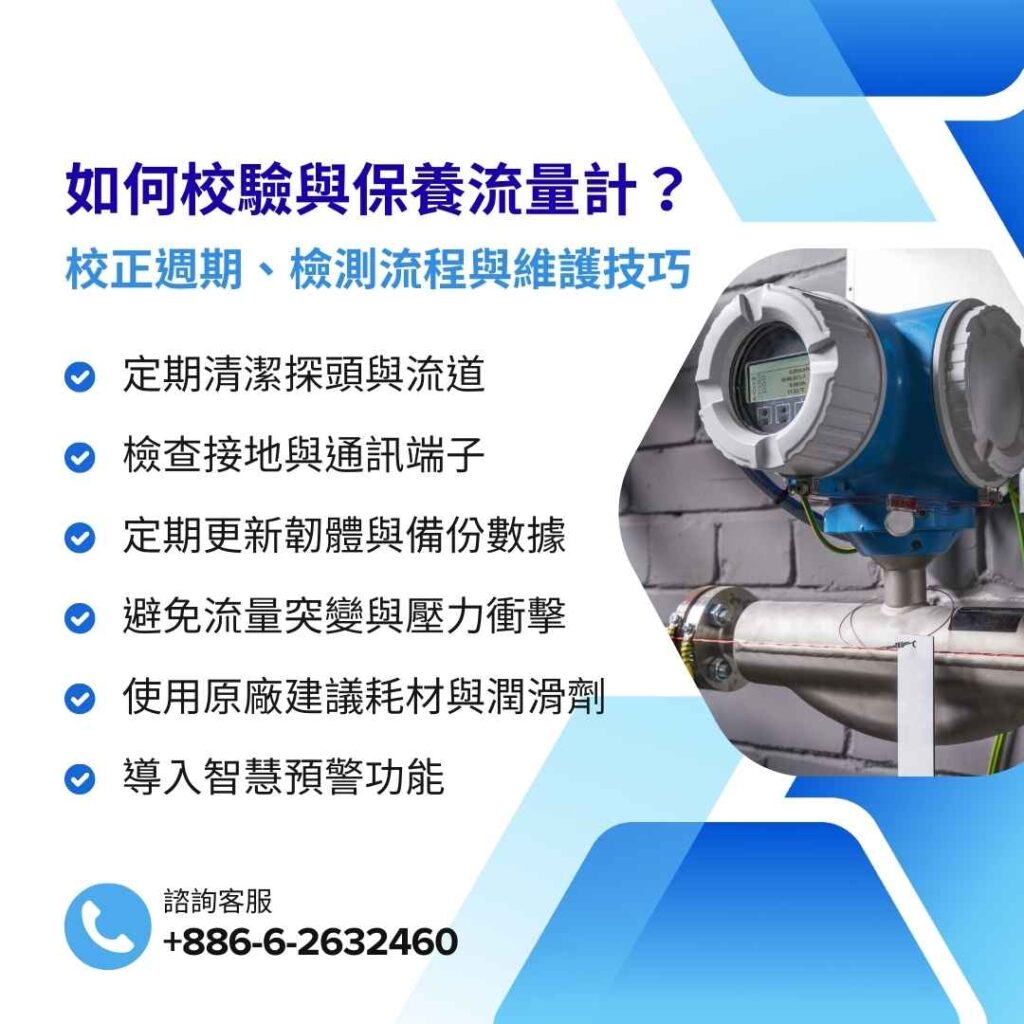
Maintenance and upkeep recommendations: Practical tips for extending lifespan
In order to maintain high accuracy of flow meters over a long period of time, in addition to regular calibration, routine maintenance is also crucial:
- Clean the probe and flow channel regularly: remove attached dirt, oil stains, and deposits to avoid affecting the sensing element.
- Check the grounding and communication terminals: Ensure that electrical contacts are clean, free from oxidation and looseness, to avoid signal interference.
- Avoid sudden changes in flow rate and pressure shocks: instantaneous changes in flow rate may damage sensors or mechanical structures.
- Use the manufacturer's recommended consumables and lubricants: Incompatible parts may cause decreased accuracy or damage.
- Regularly update firmware and back up data (digital models): fix software errors and retain historical settings for easy troubleshooting.
- Intelligent early warning function: Advanced intelligent flow meters can monitor their own status and provide early warnings of maintenance needs, reducing the risk of downtime.
Recommendations for calibration and maintenance cycles in different industries
Different industries have vastly different requirements for flow meter accuracy and different operating environments. The following are recommended calibration and maintenance cycles:
- Food industry: Verification is conducted every 6 months, in accordance with GMP requirements, to ensure the safety of formulas and production.
- Chemical industry: Verification should be performed every 36 months. If exposed to corrosive gases, the interval should be shortened to 18-24 months.
- Water treatment industry: Regularly calibrate annually, and replace O-rings and check filters at the same time to prevent water sediment from affecting the readings.
- Semiconductor/medical gas systems: must comply with ISO 17025 or equivalent testing standards, and are typically calibrated more frequently than general industrial systems (every 3 to 6 months).
Flowmeter Calibration and Maintenance FAQ
Q: Does the flow meter need to be sent back to the manufacturer for calibration every time?
Not necessarily. If qualified standard instruments and professional personnel are available on-site, on-site comparison and verification can be performed. However, for high-precision applications and in accordance with regulatory requirements, it is still recommended to return the equipment to the factory for calibration.
Q: How much error in the flow rate value is considered "needing to be recalibrated"?
Generally, calibration should be arranged for errors exceeding ±0.5% FS (full scale). For high-precision applications, ±0.1% FS can be set as the reference.
Q: If the environment is very clean, is regular calibration still necessary?
While a clean environment can slow down the decline in accuracy, component aging and electron drift can still affect the readings, so it is still necessary to perform tests according to the recommended cycle.
Q: There is no standard calibration equipment on site, how do we perform a preliminary inspection?
A preliminary judgment can be made by zero-point calibration and comparison with other flow meters that are known to be in good condition.
Q: Can I use alcohol, water, or gas to clean the probe during maintenance?
Depending on the material and model, some probes are sensitive to alcohol or high-pressure gas, so it is recommended to operate according to the original manufacturer's manual.
Q: Will replacing parts or accessories affect the calibration accuracy?
While a clean environment can slow down the decline in accuracy, component aging and electron drift can still affect the readings, so it is still necessary to perform tests according to the recommended cycle.
Q: If there are multiple flow meters in the system, can they share a single calibration process?
Batch comparisons can be performed under the same conditions, but each flowmeter still needs to be tested and recorded independently.
Q: Can the flow meter automatically indicate when it needs to be calibrated or maintained?
Some smart flow meters have runtime and performance monitoring capabilities, and can automatically alert you when a set period is reached or when an abnormality is detected.
By using the correct calibration methods and a scientific maintenance plan, you can not only extend the service life of the flow meter, but also significantly reduce the risk of unexpected downtime and quality accidents.
First General Technology Co., Ltd. boasts 20 years of experience in flow meter manufacturing, calibration, repair, and technical support. We offer comprehensive services including on-site comparison, in-factory verification, parts replacement, and smart monitoring upgrades. If your flow meter requires testing or maintenance, or if you would like to consult for the best solutions, please contact us immediately to ensure your process measurements remain at their optimal state.